
Successful Leaders Learn to Manage Their Thoughts
 Successful leadership.
There are examples of it all around us. We see it in the news, social media, our work environment (if we’re lucky), books and articles. So many people seem to just “know” how to be great leaders and it can often be intimidating for us to think that we could ever be able to achieve what we witness in the world around us.
It doesn’t just happen.
Whether you lead a company, a team or yourself, you need to know this:
Successful leaders learn how to be successful by learning how to manage their thoughts.
You see, that’s where everything starts – in your mind.
Last week I was on a video call with a colleague when she asked me if I would coach her on something. After telling me the situation she told me she had two voices in her head. One voice was telling her all the positive reasons why this would be a good thing for her. The other told her the reasons that it just wouldn’t work for her.
When she was telling me the positive reasons her body language changed, her voice became excited and I could see the passion in her eyes. When she told me the reasons why this wasn’t a good idea, she slumped, threw her head to one side and the powerful voice turned into whining.
“I feel some resistance to this, so that’s why I’m questioning it”, she said.
“What kind of resistance?” I asked.
She wasn’t sure.
I proceeded to tell her that there are all types of resistance and reasons for it. The one that needs our attention is about values and authenticity. If you go against a value you hold dear or are choosing to be inauthentic, then that resistance needs to be processed because it has to do with who you are as a person.
If the resistance has its roots in discomfort or staying small, then that’s something different all together. Your Inner Critic doesn’t want you to grow into the human being you are meant to be. Your IC wants you to stay small, safe and never risk anything.
She was still searching for an answer, so I asked her this:
“If you had to be away from your business for a while, which voice would you choose to run it in your absence?”
Nailed it.
She knew instantly which voice she would trust and which voice would lead her to where she wanted to go.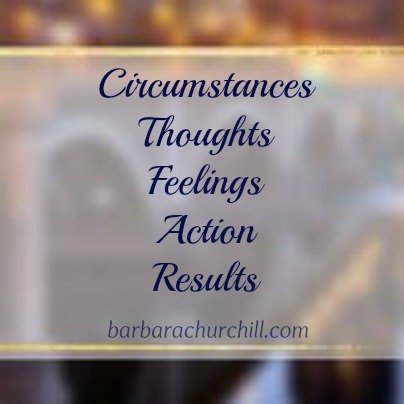
With so much mind clutter and noise vying for your attention, you as a leader must be able to discern which thoughts get your attention and which ones you leave by the wayside.
When faced with thoughts that don’t serve you, the ability to shift them to ones that do is essential. Noticing them when they show up, detaching from the emotional pull they try to create and replacing them with ones that are in line with your vision for your company, team or life will enable you to make decisions that support rather than derail.
Now, it’s not just about choosing happy thoughts to replace the negative ones and life will be all peachy keen. There’s actually a sequence that we follow:
CIRCUMSTANCES: a provable fact
↓
THOUGHTS: a sentence in your mind
↓
FEELINGS: an emotion
↓
ACTIONS: behavior
↓
RESULTS: outcome of that behavior
We can’t control what’s happening in the world (circumstances), however, we can control the thoughts we have about what’s happening in the world. This is where the power lies. We think that our feelings run how we act – that they just “happen” and we have no control over them. Ever hear someone say they’re an emotional person, that’s just how they’re built? They believe they have no control over what they feel. Not so.
Your feelings are caused by the thought you’re having in that moment. If you want to change how you feel, you’ll need to change the thought you’re thinking.
For example:
Circumstance: Meeting today at 3:00
Thought: I hate all these meetings! I never have time to get my own work done.
Feeling: Frustrated
In order to feel differently, you’ll need to change the thought you’re having about the meeting. Ask yourself, “How do I want to feel?”
You may not be able to go from one extreme feeling to the other extreme – sad to happy – that’s normal. You will be able to choose a feeling that feels better and create a thought that supports that feeling.
By practicing this regularly you will begin to see patterns emerge and identify what triggers them, while understanding how your feelings are totally influenced by the thoughts you have.
You may have heard the quote that good leaders are born, not made.
I respectfully disagree.
Great leaders learn how to be great by first learning how to manage their minds, so the actions they take support their vision and goals.
You have it in you to be a great leader, too.
What do you think?
If you’d like more information on coaching with me, please contact me and I’ll be happy to answer any questions you have. I have a couple spots open in my schedule and I’d love to add your name!